European Exploration and Colonization
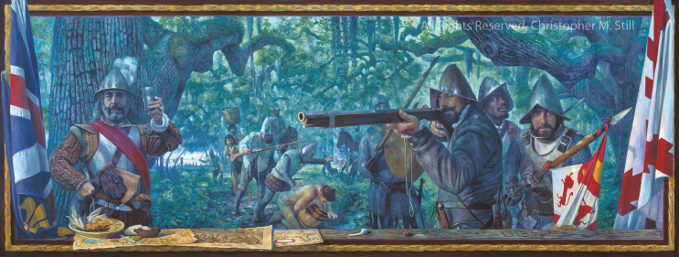
La Florida, painting by Christopher Still
Spanish explorer Juan Ponce de León landed on Florida's east coast in 1513. He called the area "La Florida." Over the next fifty years, three Spaniards tried, but failed, to create permanent settlements in Florida. The French built a fort and settlement near Jacksonville, but it only lasted about a year. Spain finally achieved a permanent settlement when St. Augustine was founded in 1565.
The Spaniards established Catholic missions among the Apalachee and Timucua Indians. During the 1600s, many Florida Indians died of diseases. In the 1700s, Spanish Florida was attacked several times by English and French forces. The missions were destroyed, and many Indians were killed or enslaved. Later, the ancestors of today's Seminole and Miccosukee Indians, created new settlements in Florida.
In 1763, Britain took control of Florida and divided the land into East and West Florida. St. Augustine and Pensacola were the capitals of these two colonies. During the American Revolution, the two Floridas remained loyal to Britain.
Spain took control of Florida again after the American Revolution. Spanish and American settlers came to Florida. Enslaved Blacks escaped to Florida to seek their freedom. From 1817 to 1818, the U.S. government engaged the Seminole Indians in the first of three wars. When Spain transferred the peninsula to the United States in 1821, Florida became a U.S. territory.
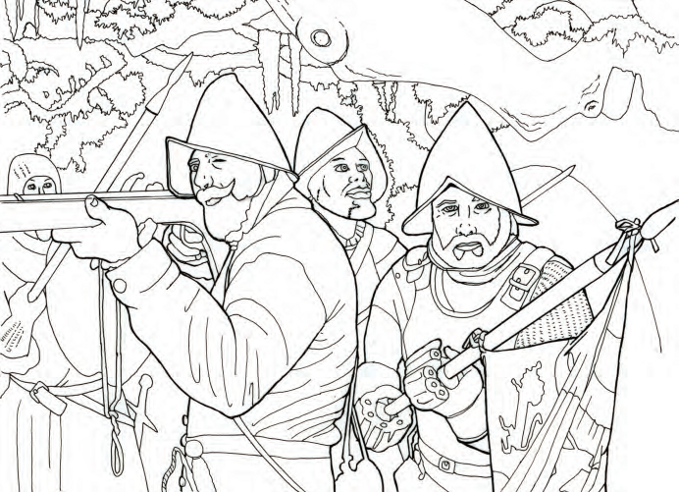
1. Identify at least 5 different items in the picture above that make up the uniform worn by the Spanish explorers.
2. Go to christopherstill.com/fl-house-of-reps and click on the picture that matches the painting above.
3. Click on "Go to link" to learn more about the items you identified.
4. Go to floridamemory.com/items/show/11973.
5. How is the U.S. soldier uniform in the picture online different from the one worn by the Spanish explorers? How is it similar?
Free Play
What do you know about Florida geography in 1776?
By 1776, the Florida peninsula had been colonized, and people were traveling across the northern part of the state. As people became more familiar with interior and maritime boundaries in Florida, they documented the changes on maps and charts.
Cartographers are people who make maps and charts. They identify rivers, bays, forts, roads, and political boundaries of an area, such as cities, towns, and counties. Studying these documents can show us how knowledge of the geography of an area changed over time.
Your task for this Free Play is to compare a map of Florida from 1776 with a map from 1857 and identify the changes.
Directions
1. View the 1776 Florida map found below. Click the link to enlarge.
2. Compare the 1776 map with the 1857 map of Florida found also found below. Click the link to enlarge.
Questions to Answer
1. The 1776 map includes words in Spanish. Why would Spanish names appear on an English map?
2. What natural feature formed the border between East and West Florida? What river marked Florida's western border?
3. Examine the enlarged view of St Augustine. Where are the buildings? How many churches are identified? What was the unit of measurement used?
4. What is the modern location and name for Lake Mayaco? What evidence supports this conclusion?
5. What is the modern name for Cow Ford? What about General Mount?
6. What major body of water to the southwest of Florida is represented on the 1776 map? What is the modern name for this body of water?
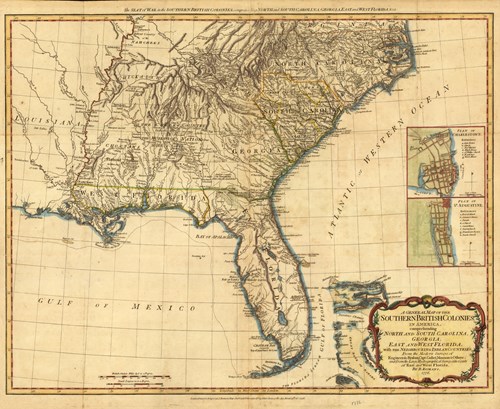
Map from 1776, State Archives of Florida, Florida Memory, floridamemory.com/items/show/323271
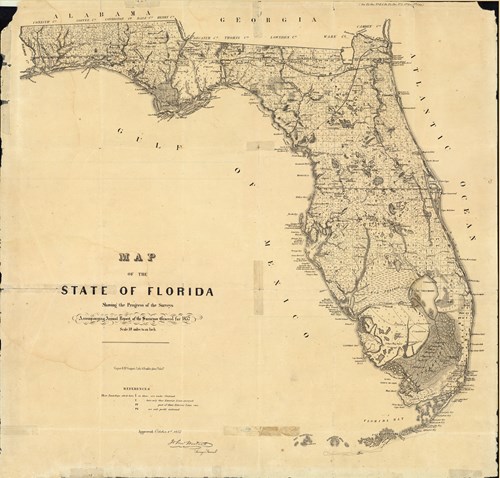
Map from 1857, State Archives of Florida, Florida Memory, floridamemory.com/items/show/323192